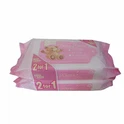
The main ingredients of wet wipes are spunlace non-woven fabric, water and additives.
Non-woven fabric is a fabric that does not require spinning and weaving. It is made by directly bonding fibers together either physically (mechanical, thermal bonding) or chemically. The raw materials of non-woven fabrics can be diverse. Nonwoven fabrics are divided into various types based on manufacturing methods. Among them, spunlace non-woven fabrics spray high-pressure fine water jets onto one or more layers of fiber webs to entangle the fibers with each other, so that the fiber webs can be reinforced and have a certain strength. It can ensure that it feels particularly soft and thick, while also having a certain tensile strength. Others are non-woven fabrics made through melt bonding, spun bonding and other processes. In addition to processing factors, the quality of non-woven fabrics also depends on the selected raw materials. This is generally not stated in the ingredient list, so mothers can only choose based on comprehensive judgment with other ingredients.
The liquid content of wet wipes generally accounts for about 80%. If the content of the wet wipes is too little, it will feel dry. On the contrary, if the content is too high, it will feel too wet and inconvenient to use. Therefore, after testing, the proportion of medicinal solution is generally around 80%. More than 90% of the liquid medicine is water. In order to prevent the components in the water from reacting with the components of the medicinal solution, the water used in wet wipes must be specially treated water. This is the meaning of "purified water", "purified water" and "RO pure water" marked in the ingredient list.
There are various additives in wet wipes, and the differences between wet wipes of various brands are also the greatest. Most additives are labeled with chemical names that the average consumer doesn't understand. In fact, although the products used are different, the effects are the same. The key is what these raw materials are used for.
1. Moisturizer
Propylene glycol is a solvent and humectant. It can help the active substances in the medicinal solution dissolve in the water, making the water less volatile, and has antibacterial and antiseptic effects, so almost all wet wipes used contain it.
2. Preservatives (phenoxyethanol, methyl paraben, paraben)
Wet wipes contain a lot of water and different substances. In order to maintain the activity of the active substances, preservatives must be added, but in such low amounts that they do not have negative effects. In order to combat different types of bacteria, the same wipes often contain a combination of several preservatives. This also shows that everyone must pay attention to the production date and use date when purchasing wet wipes. It is best not to use wipes that are expired or have been produced for a long time.
3. Antibacterial agents (sodium lactate, eucalyptus)
There are many types of antibacterial agents, including chemically synthesized antibacterial agents and natural antibacterial agents. As the name suggests, they destroy bacteria and inhibit bacterial growth.
4. Chelating agent (Tetrasodium Hydroxyethyl Phosphate)
The function of chelating agents is to react with heavy metal ions in water or raw materials so that these heavy metal ions will not be absorbed by the baby's skin with the use of wet wipes.
5. Other natural ingredients
Eucalyptus leaf extract: natural fungicide
Chamomile Oil: Soothing and anti-inflammatory
Aloe vera essence: moisturizing effect
The wet wipes currently on the market have ingredients that comply with usage standards, so there is no need to worry about safety issues.